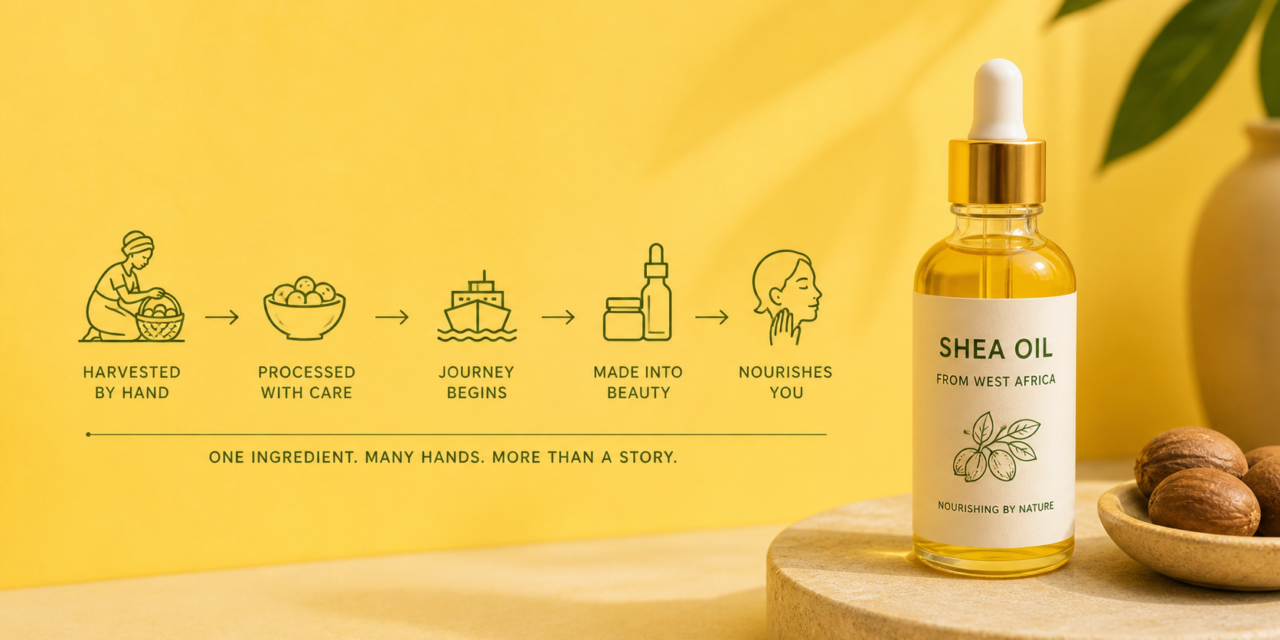
A bottle of essence on a retail shelf reflects nourishment, origin and care. Labels reference plants, regions, sometimes communities, suggesting a direct line from source to skin. But behind that simplicity lies a more uneven reality: while many beauty ingredients originate in Africa, the people and places they come from often capture the least value as those products move through global markets.
Take shea butter, for example, which is widely used across beauty formulations. Much of it originates from West Africa, with major production happening in countries like Ghana and Burkina Faso. The process begins with the harvesting of shea nuts, followed by drying, crushing, roasting, and extraction. Much of this work is carried out by women, often in cooperative structures or informal groups.
The early stages of this process are labour-intensive and often undervalued:
From raw material to global product
The United Nations Conference on Trade and Development has highlighted how many commodity-based value chains function, with raw materials exported and processed elsewhere, capturing higher value at later stages. Shea follows a similar pattern. While some processing occurs locally, a significant portion is exported for refinement and incorporation into finished products.
By the time it appears on international shelves, the ingredient has passed through multiple stages. Each stage adds value, but that value is unevenly distributed. African producers, particularly the women who do much of the labour-intensive work, often remain at the bottom of this chain, receiving the smallest share of the final profit while global brands capture the premium margins through processing, packaging, branding, and marketing.
This pattern extends beyond shea. Baobab oil, argan oil, and other botanical ingredients follow similar trajectories. The origin remains central to the narrative, yet the economic benefits often concentrate further along the chain.
Local production and its constraints
Efforts to retain more value within producing countries are ongoing. Small and medium enterprises are developing capacity to process and package ingredients locally. In Senegal and Kenya, brands are emerging that are placing emphasis on local production from source to shelf.
These initiatives face structural challenges. Access to financing, certification, and international distribution networks remains limited. Competing with established global brands requires more than quality. It requires visibility, consistency, and scale.
The African Development Bank has identified value addition in agriculture and natural products as a key opportunity for economic growth. Beauty ingredients sit within this broader context.
Rethinking origin and ownership
Consumers increasingly seek products with clear origins and ethical sourcing claims. This creates pressure on brands to provide transparency. It also creates an opportunity to rethink how origin is represented.
An ingredient’s journey does not end at extraction. It includes processing, branding, and distribution. Recognising this full journey shifts attention from where something comes from to how it moves and who benefits along the way.
Beauty, in this sense, becomes a lens through which broader economic patterns are visible. It reveals how resources are valued, how labour is recognised, and how narratives are constructed around both.
The bottle on the shelf remains simple. The system behind it rarely is.
The bottle on the shelf remains simple and beautiful. The system behind it rarely is. Until African countries and communities capture a much larger share of processing, branding, and profits in these global value chains, the promise of the green beauty economy will continue to leave the very people whose resources and labour make these products possible at a disadvantage.