We Replaced a Carbon-Neutral Home with Concrete, Then Started Looking for Sustainable Alternatives
In an era of green building certifications, net-zero targets and sustainable architecture conferences, it is easy to assume that environmentally responsible housing is a relatively recent innovation.
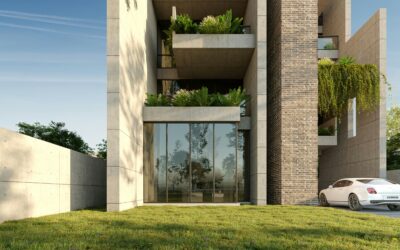
However, sustainable features have existed since ancient times. A solid example of this is the archetypal Zulu dwelling called iqhugwane which once formed part of everyday homestead life. A circular, beehive-shaped dwelling made from grass, saplings and earth, it emerged from materials drawn directly from the surrounding environment. In many places it has now largely disappeared from use, replaced by brick, concrete and corrugated iron structures, materials that were once introduced as symbols of permanence, but now often struggle with heat, cost and maintenance in the environments they were meant to improve.
Iqhugwane sits within a wider architectural tradition that shaped settlement patterns across many parts of Africa. Circular homesteads were not decorative choices. They organised social life spatially, movement, labour and family structure all unfolding within a layout that was as functional as it was cultural. What is striking in hindsight is how much of this organisation required no separation between environment and habitation.
How structures worked with tension
For iqhugwane, construction began with saplings selected for flexibility, planted into the ground in a circular formation and bent inward to form a dome-like frame. The structure relied on balance and tension rather than rigid fastening. Each pole only worked because of the others, a system that would collapse if isolated, but held when treated as interdependence rather than individual strength.
It is difficult not to notice how modern construction, for all its engineering precision, often solves stability by increasing separation. It seems to have stronger materials, deeper foundations and far heavier inputs. Iqhugwane did the opposite by stabilising through relation. Once the frame was established, grass was gathered, dried and sorted before being layered onto the structure from the base upwards. Thatching was slow, repetitive work, but it produced something modern materials often struggle with, a surface that breathes. Each layer overlapped the previous one and not necessarily for aesthetic effect, but for functionality.
Inside, the floor was formed from compacted earth, often treated with natural mixtures like soil and cow dung. The result was a managed interior climate, achieved without mechanical intervention, insulation boards or imported systems.
Communal work
This system was so efficient and really quite difficult to reduce to architecture alone. Women carried much of the material preparation and thatching work, selecting grasses, sorting them by quality and length, and managing the layering process that determined durability. The precision involved was often underestimated precisely because it was familiar.
Men typically sourced and shaped the structural poles, forming the frame that carried the weight of the dwelling. Children moved this system too, carrying, observing, repeating. What stands out is how little the division of labour resembled hierarchy in the modern sense. It functioned more like distribution.
Transition to ‘modern’ structures
Across many parts of Africa, including eSwatini, Burundi, Rwanda and many other countries, variations of this architectural system have similar principles. Circular homesteads organised around shared central spaces reflected a spatial logic that predated the formal grids and property divisions that would later define many settlements. Over time, this system evolved into what is now called the rondavel, a form that preserved the circular base but introduced vertical walls, more durable materials, and increasingly fixed boundaries between inside and outside. Brick and cement carried an idea of progress that repositioned older systems as transitional. Thatch did not fail technically, but it has been reclassified. That reclassification still echoes in how “traditional” building is spoken about today – as heritage, as culture, and rarely as current knowledge.
Sustainability’s late arrival to history
Modern sustainability discourse often presents itself as corrective, framed as reducing emissions, improving efficiency, rethinking materials, designing with climate in mind. There is nothing superficial about these efforts, but they also tend to assume a starting point as if the problem begins at the moment it is defined. Yet many of the principles now treated as innovation were already embedded in older building systems. These include local sourcing, cyclical material use, low-waste construction, climate responsiveness through design rather than technology. The irony is how easily these were rendered invisible by the language of progress. What gets framed as discovery, especially by western culture, is often delayed acknowledgement.
No need to go backwards
None of this requires turning the past into an ideal. Iqhugwane is not universal, nor static, nor immune to change. It existed within specific social and ecological conditions that cannot simply be transplanted into the present. But it does reveal something that modern sustainability discussions often struggle to hold at scale, which is the fact that living within environmental limits does not automatically require technological mediation. Sometimes it requires attention to what is already available, and an understanding of how systems hold together through relation rather than extraction.
The older systems weren’t exactly but they complicate the assumption that sustainability is primarily a future project. Because if parts of it already existed in everyday practice, then the question is no longer how to innovate toward sustainability. The fresh question is how to recognise what was is already working and incorporate it rather than destroy it. This approach would have definitely saved us much in heath and finance.